Toward a Unified Framework for AI Integration in the Business Ecosystem
From theoretical complexity to operational strategy: a two-dimensional approach to AI adoption in mid-sized companies.
Discover the frameworkWhy Do We Need a Conceptual Framework?
Organizations face a paradox: many theoretically sophisticated frameworks for AI adoption exist, yet practical implementation remains complex and fragmented.
The "Crisis of Fragmentation": Existing frameworks excel in specialist domains but lack systemic integration across strategy, operations, technology, and organization. Recent research defines this situation as a "crisis of fragmentation" in enterprise AI tools: organizations implement dozens of different AI tools even within single functional domains, while a significant share of initiatives remains stuck in "pilot purgatory" — the inability to move beyond experimentation.
This framework closes the gap by combining:
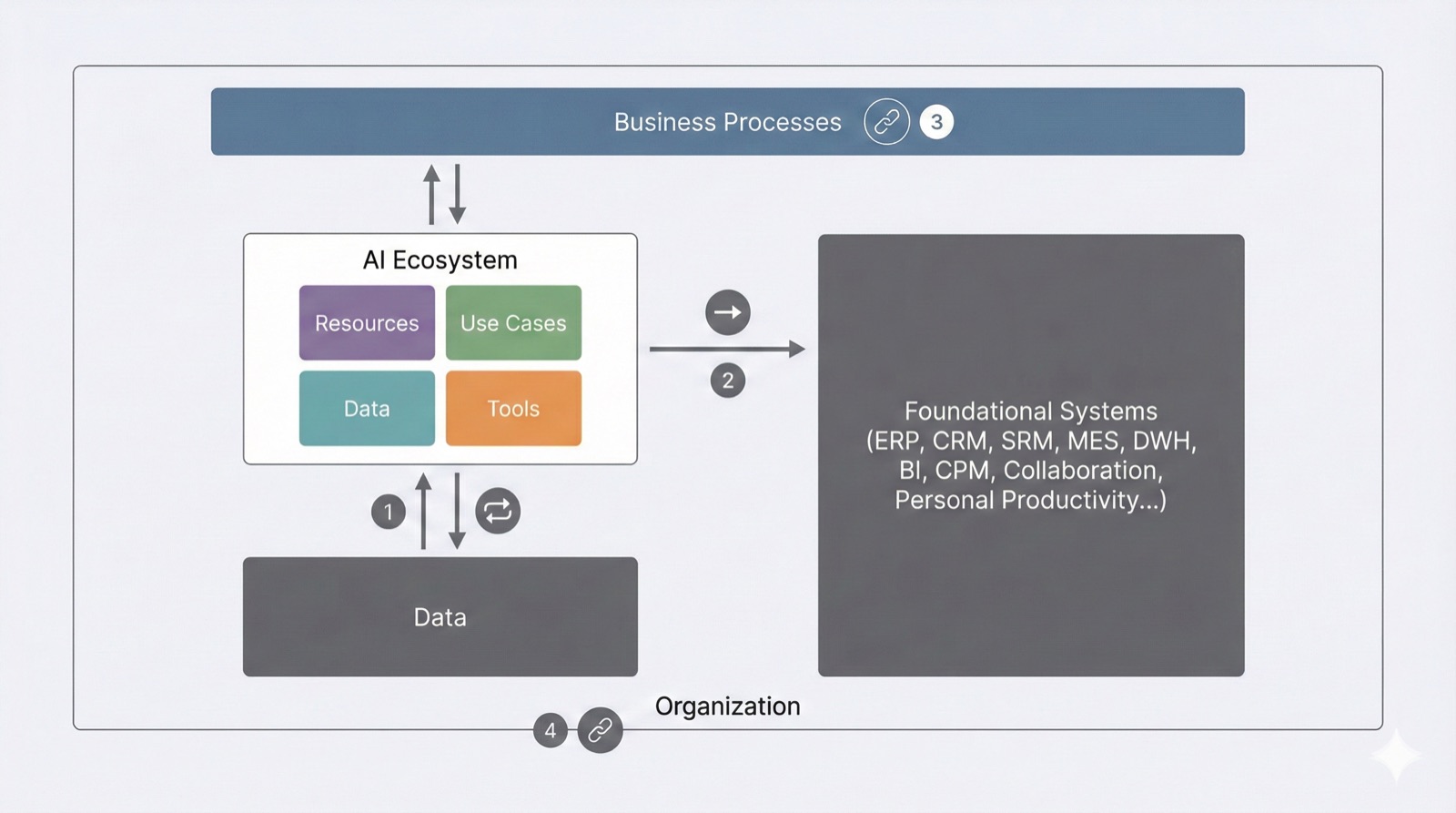
Two-Dimensional Architecture
4 integration levels × 4 functional domains for a complete and operational view of the AI ecosystem. Not a flat list of components, but a matrix that captures interdependencies between integration modes and functional areas.
Operationally Implementable
From theory to practice: concrete use cases, detailed activation maps, clear technology choices with explicit trade-offs. Each framework level translates into specific actions, identifiable tools, and measurable outcomes.
Tailored for Mid-Sized Companies
Calibrated to real constraints, limited resources, and the organizational complexity of Italian SMEs. Unlike frameworks designed for large corporations, this approach recognizes that mid-sized companies have organizational flexibility but limited transformation capacity.
The Four Levels of Integration
From coexistence to transformation: AI must be progressively grafted into the existing business context.
Bidirectional Data ExchangeEcosystem ↔ Data
The AI ecosystem operates as an interconnected system that extracts, uses, organizes, and consumes data from the business context, while simultaneously generating new data that is returned and integrated.
This represents the foundational level of interaction, characterized by a dynamic and circular flow of information. The AI tool is an external agent that interfaces with business systems: it reads data (input) and writes results (output), but does not modify existing processes. It is the level of "peaceful coexistence".
Distinctive feature: Unlike other technological clusters that are containers to be filled, in Generative AI even newly adopted models have their own "initial endowment" (derived from training) that brings a large amount of data and information into the company, immediately relating to internal data.
Concrete example: A chatbot that queries the CRM to answer customer questions, without changing operational procedures.
Unidirectional ActionAI → Operating Systems
AI tools act directly on foundational systems through access, execution, piloting, and command operations.
AI does not only read and write data, it can also trigger operational actions: update records, send notifications, start workflows. It becomes an "executor" operating under human or automated delegation.
This level represents a more operational and direct interaction, where AI can take an active role in managing existing systems with a view to automation or "agency".
Concrete example: An intelligent automation system that, upon detecting an anomaly, automatically creates a support ticket, assigns priority, and notifies the responsible team.
Definitive Integration of ProcessesAI ⊂ Business Processes
The AI ecosystem integrates into business processes, defining proprietary processes and altering existing ones.
AI is no longer an external tool, but an integral part of the process: operating procedures are redefined to assume the presence of AI. Processes become "AI-native".
This level entails a structural transformation of organizational workflows, where AI becomes embedded in operational logic.
Concrete example: A credit scoring process that natively integrates ML models in risk assessment, redesigning underwriting phases and decision criteria.
Definitive Integration of the OrganizationAI ⊂ Organization
The deepest level of integration, where the AI ecosystem inserts itself into the organization, defining new organizational structures, roles, and competencies.
AI transforms the organization itself. New roles emerge (AI Trainer, Prompt Engineer, AI Operations Manager), required competencies evolve, and the organizational structure is redesigned to maximize AI value.
It represents the deepest transformation of the corporate structure: not only do processes change, but the organization reorganizes around AI competence centers, modifying KPIs and reward systems.
Concrete example: An organization that introduces the role of "AI Operations Manager" and reorganizes teams around AI competence centers, with new KPIs, reporting structures, and incentive systems aligned with AI transformation.
The Four Functional Domains
Systemic interdependence and complementarity: the four domains operate in synergy, not as isolated components.
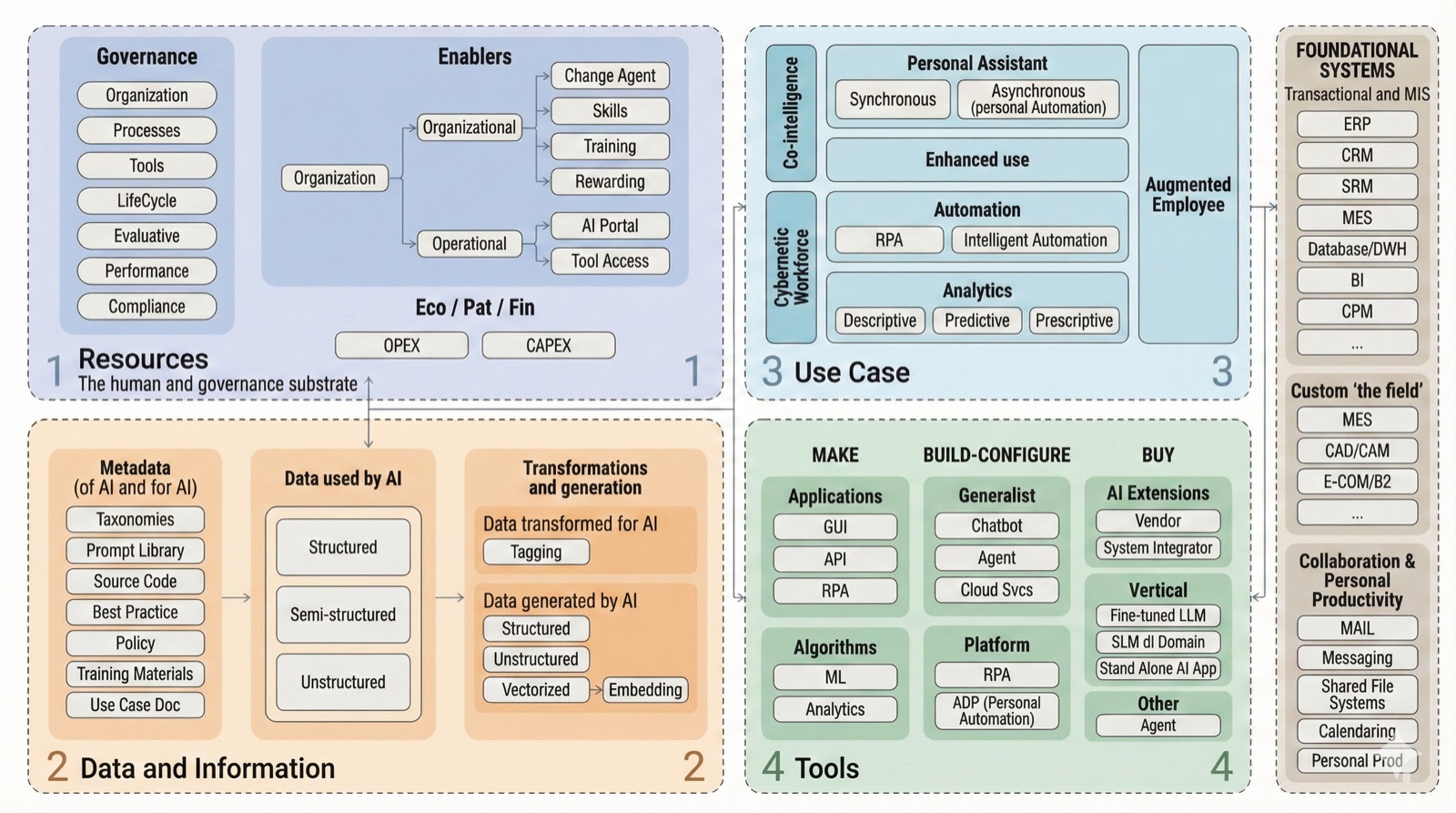
Resources
The set of all "soft" resources primarily focused on human resources that sustain, support, and form the backbone of the ecosystem. They are articulated into three main categories:
Governance Resources: Dedicated organizational structures (strategic committee, center of excellence, operational committee), dedicated processes (use case lifecycle management, performance evaluation, AI Act compliance), and management tools (adoption KPIs, reporting, business cases, risk evaluation models).
Transformation Enablers: Change agents trained and incentivized, specific rewarding to recognize results, democratic access to approved tools, and the AI Portal that organizes resources, use cases, and tools.
Financial Resources: CAPEX (adoption projects, training, tool development) and OPEX (licenses, cloud capacity, cost of dedicated human resources). Includes complete economic frameworks that go beyond traditional ROI, incorporating specific metrics for network effects, continuous learning, and process transformation.
Use Case
Use cases represent the concrete ways through which AI integrates into work processes. They fall into two fundamental paradigms:
Co-Intelligence ("Centaur" paradigm): AI amplifies human capabilities while keeping decision control with the operator. Includes Synchronous Personal Assistants, Asynchronous Personal Assistants, and Enhanced Use. Prevailing goal: "individual super-productivity".
Cybernetic Workforce ("Cyborg" paradigm): Human-machine integration reaches levels where the boundary between human and artificial action becomes indistinguishable. Includes Automation (RPA and Intelligent), Analytics, and Augmented Employee. Prevailing goal: "process productivity".
The classification reflects different collaboration philosophies, increasing levels of technological integration, and differentiated degrees of automation of cognitive and operational processes.
Data & Information
The domain is structured into four macro-categories with a circular, self-feeding nature:
Metadata (of AI and for AI): The informational backbone that sustains the ecosystem. Includes taxonomies, Prompt Library (a strategic repository of optimized query patterns), source code, best practices, policies, training materials, and use case documentation.
Data Used by AI: The primary input. Includes structured data (databases, ERP, CRM, DWH, BI), semi-structured data (accounting documents, XML, JSON, email), and unstructured data (free text, images, video — the most voluminous category where modern AI excels).
Data Transformed for AI: Preparation processes that make data computable. Includes tagging (annotation and labeling) and embedding (conversion to vector representations that preserve semantic relationships).
Data Generated by AI: Output of the processing activity: structured data (analysis, forecasts, classifications), unstructured data (generated content), and vectorized data (representations reusable for specialized knowledge bases). Generated data can become input for subsequent processing, requiring architectures that guarantee consistency and traceability.
Tools
The variety of available tools suggests the scale of complexity. The Make, Build-Configure, Buy classification is not merely technical but reflects different innovation management philosophies, with implications for investment, skills, timing, and governance.
Make (In-House Development): Maximum flexibility and control, high complexity. Includes applications, algorithms, GUI, API, RAG, ML, and analytics developed internally. Potential for sustainable competitive differentiation.
Build-Configure (Platform Customization): Balanced approach. Includes generalist chatbots, configurable agents, cloud services (OpenAI API, Claude API, Azure OpenAI), RPA platforms, ADA. Reduces time-to-market and risk while retaining customization capacity.
Buy (Solution Acquisition): Immediate access to proven technologies. Includes AI extensions from vendors (SAP HANA AI, Oracle AI, Salesforce Einstein), system integrators, fine-tuned vertical LLMs, standalone AI apps, domain SLMs, embedded AI, and pre-built agents. Minimizes time and risk, maximizes reliability.
Use Cases: Two Fundamental Paradigms and 7 Usage Models
The philosophical distinction between human augmentation (centaur) and automation (cyborg) defines the nature of AI adoption. The seven usage models articulate how AI is concretely implemented.
Co-Intelligence
Augmented Intelligence: AI enhances human capabilities, the human retains final decision control.
- Personal Assistants (synchronous and asynchronous) for real-time or autonomous individual support
- Enhanced Use: AI integrated into existing tools without changing the familiar interface
- Focus on decision-making, creativity, and strategic reasoning
- The human deliberately retains final decision control
- Paradigm: "Centaur" — human-AI symbiosis where skills complement each other
- Goal: Individual super-productivity, amplification of cognitive capacity
Distinctive philosophy: Complementarity between human intuition and AI computational capacity, between human creativity and AI generative capacity, between human contextual judgment and AI pattern recognition.
Cybernetic Workforce
Intelligent Automation: AI operates autonomously, humans supervise. The boundary between human and artificial action becomes progressively indistinguishable.
- Automation (RPA and Intelligent): repetitive processes with deterministic or adaptive logic
- Analytics (descriptive, predictive, prescriptive): transforming data into actionable intelligence
- Augmented Employee: AI as a digital collaborator with domain expertise
- AI assumes operational and decision responsibility in defined domains
- Paradigm: "Cyborg" — AI as an integrated digital workforce
- Goal: Process productivity, intelligent automation, specialized decision support
Transformative characteristic: Creation of hybrid workflows where operational responsibility and decision authority are distributed between human and artificial intelligence in a fluid, contextual, and often indistinguishable way, creating efficiencies that significantly exceed performance achievable by human-only or AI-only approaches.
The Seven Usage Models
Personal Assistant - Synchronous
This mode includes all synchronous interactions with conversational platforms such as ChatGPT, Claude, Gemini, or Copilot. The user submits specific requests to receive immediate responses used to complete complex cognitive tasks: document writing, problem analysis, idea generation, technical Q&A, translations, document summaries, creative content creation, and strategy development.
Distinctive characteristics:
- Requires active and continuous user presence
- Dynamic iteration with critical evaluation of responses
- Output quality depends on prompt engineering skills
- Support for reasoning and information retrieval
- Delegation of tasks to regain efficiency
Typical tools: ChatGPT, Claude, Gemini, Copilot, generalist conversational platforms.
Systems involved: Collaboration & personal productivity (Mail, Messaging, File Systems).
Concrete example: A working session with ChatGPT for in-depth analysis of a multidimensional business problem, with iterative refinements.
Personal Assistant - Asynchronous
Includes the strategic use of AI agents that can operate with significant temporal autonomy: customized OpenAI GPTs, configurable Claude agents, MCP connectors, automation with Microsoft Power Platform or Copilot Studio. These agents maintain context, access external tools, and execute asynchronous operations.
Distinctive characteristics:
- Autonomous operation with limited supervision
- Persistent memory and multi-step capabilities
- Delegation of structured yet cognitively demanding tasks
- Results available at a later, optimal time
Typical tasks: Systematic monitoring of information sources, periodic processing of complex reports, automated approval flows, data processing operations with validation, automated generation of personalized content.
Typical tools: Custom GPTs, Copilot Studio, Manus, Genspark, Perplexity Pro, configurable agents, Microsoft Power Platform.
Concrete example: An agent that monitors specific competitive intelligence sources daily and generates weekly reports with summaries of relevant information.
Enhanced Use
Strategic use of AI extensions provided by existing system vendors (SAP HANA AI, Oracle AI, Salesforce Einstein) or implemented by system integrators. These solutions significantly enrich existing functionality without requiring complex development or architectural redesign.
Distinctive characteristics:
- Native integration that minimizes learning curves
- Reliability from vendor testing
- Simplified governance that inherits existing policies
- Immediate benefit from existing security frameworks
Representative examples: SAP HANA AI (demand planning, inventory management), Oracle AI (sales forecasting, churn prediction), Salesforce Einstein (lead scoring, sales opportunities), Microsoft 365 Copilot (meeting summaries, document analysis, content assistance).
Limitations: Reduced customization flexibility, dependency on vendor roadmaps.
Concrete example: Microsoft 365 Copilot integrated into Word for writing assistance, Excel for data analysis, PowerPoint for presentation creation, and Teams for meeting summaries.
Automation - RPA
RPA represents the automation of processes with deterministic logic through platforms like UiPath, Automation Anywhere, and Blue Prism. It enables the automation of operational tasks involving interactions with multiple digital interfaces, manipulation of structured/semi-structured data, transfer of information between systems, and execution of procedural workflows.
Distinctive characteristics:
- Operates according to well-defined deterministic logic
- Requires well-documented and standardized processes
- Limited variability for optimal effectiveness
- High reliability and measurable short-term ROI
Typical examples: Automation of data entry from structured documents, automated handling of administrative cases (expense approvals, purchase orders, customer onboarding), automated invoice and order processing with validation, data synchronization between systems.
Typical tools: UiPath Studio, Blue Prism, Automation Anywhere, WorkFusion.
Systems involved: ERP, CRM, SRM, Database/DWH, BI, CPM, MES, CAD/CAM, E-commerce.
Concrete example: A system that automates invoice processing by extracting data, validating against contracts, updating financial systems, and generating exception reports.
Intelligent Automation
Represents the strategic evolution of traditional RPA through integration with large language models and machine learning to handle scenarios requiring contextual understanding, sophisticated reasoning, and adaptive decisions based on learned logic.
Distinctive characteristics:
- Ability to adapt to variations in input data
- Understanding of contextual nuances
- Learning from historical patterns
- Decisions based on probabilistic logic
Characteristic examples: Automated document understanding (contracts, variable invoices, email), intelligent email processing with classification and sentiment analysis, automated classification of business content, automated management of process exceptions with dynamic decision trees.
Autonomous agents: An evolution that pursues goals based on a set of skills, searching for or creating information to complete tasks.
Typical tools: AI-enhanced RPA platforms (UiPath AI, WorkFusion), LLM cloud services, ML frameworks.
Concrete example: A system that processes customer emails by automatically classifying them, analyzing sentiment, identifying urgency, and routing them to the appropriate team with contextual response suggestions.
Analytics
Analytics leverages machine learning algorithms, statistical modeling, and AI techniques to transform business data into informational value, articulated across three levels of increasing sophistication.
Descriptive Analytics: Analysis of historical data to understand what happened — identifying patterns, trends, correlations, and anomalies. Examples: sales performance analysis, customer behavior analysis, dynamic dashboards for KPI monitoring.
Predictive Analytics: Use of ML algorithms to predict future events with confidence intervals. Examples: demand forecasting, predictive maintenance, credit scoring, churn prediction, market trend forecasting.
Prescriptive Analytics: The most advanced level, combining predictive capability with optimization algorithms to recommend optimal actions. Examples: dynamic pricing optimization, workforce planning, end-to-end supply chain optimization, real-time offer personalization.
Typical tools: ML algorithms, analytics platforms, Python/R, TensorFlow, Azure ML, AWS SageMaker.
Concrete example: A predictive system that analyzes machine usage patterns and sensor data to anticipate failures 3-4 weeks in advance, enabling preventive maintenance.
Augmented Employee
The most sophisticated category of the Cybernetic Workforce, characterized by specialized AI applications developed with LLMs via cloud APIs, RAG architectures, vector databases, and a modern technology stack to amplify knowledge worker capabilities.
Distinctive characteristics:
- Deep customization around domain expertise
- Seamless integration into existing workflows
- Significant added value and competitive differentiation
- Requires investment in technical talent and cloud infrastructure
Representative examples: Legal AI (contract analysis, due diligence), Medical AI (diagnostic support, treatment recommendations), Financial AI (risk assessment, algorithmic trading), Knowledge Management Systems (RAG for institutional knowledge), Content Generation Platforms (marketing, documentation), Training Environments (personalized learning paths, adaptive assessment).
Typical tools: Custom development with LLM APIs (OpenAI, Anthropic, Google AI, Azure OpenAI), RAG architectures, vector databases (Pinecone, Weaviate), ML frameworks.
Concrete example: A RAG system for enterprise knowledge management that combines technical documentation, best practices, and knowledge bases with natural-language querying, providing accurate answers with source citations.
Technology Strategies: Make, Build-Configure, Buy
Every technology choice is as strategic as the definition of the use case. The three categories balance complexity, flexibility, cost, and time-to-market.
Make
Maximum flexibility and control, but high complexity. Full internal development of solutions to create sustainable competitive differentiation. Requires advanced skills and significant investment.
Subcategories
- Applications: End-to-end development with full software engineering, AI/ML, and UX design capabilities.
- Algorithms: Proprietary ML models, advanced optimization algorithms — intellectual property that forms competitive advantage.
- GUI: Customized graphical interfaces for optimized user experiences, including custom chatbots.
- API: Programmatic access to LLMs through OpenAI API, Anthropic Claude API, Google AI API, Azure OpenAI Service.
- RAG: Customized architectures combining proprietary databases with LLMs for business-critical cases: knowledge management, specialized assistants, support Q&A.
- ML: Full pipelines from data engineering to deployment: computer vision, NLP, anomaly detection, deep learning.
- Analytics: Complete platforms for enterprise data lakes, real-time processing, strategic planning.
✅ Pros
- Maximum customization and full control
- Sustainable competitive differentiation
- No vendor dependency
❌ Cons
- Significant investments required
- Advanced skills needed
- Longer time-to-market
Build-Configure
Balanced approach combining customization flexibility with the stability of mature platforms. Reduces time-to-market and technical risk while retaining customization capacity.
Subcategories
- Generalist: Chatbot: Direct access to conversational platforms (ChatGPT, Claude, Gemini, Copilot) for immediate conversational capabilities.
- Generalist: Agent: Semi-autonomous agent use with temporal autonomy and persistent memory: Copilot Studio, Manus, Genspark, custom GPTs.
- Generalist: Cloud Services: API access to OpenAI API, Anthropic Claude API, Google AI API, Azure OpenAI Service with automatic scalability and high availability.
- Platform: RPA: Mature enterprise platforms (UiPath Studio, Blue Prism, WorkFusion) with visual development environments and pre-built connectors.
- Platform: ADA: Specialized tools (Microsoft Power Automate Desktop, UiPath StudioX) for knowledge-intensive desktop process automation.
✅ Pros
- Balance of flexibility and stability
- Reduced time-to-market and risk
- Infrastructure managed by provider
❌ Cons
- Vendor dependency
- Limited customization vs in-house development
- Still requires technical skills
Buy
Lower flexibility but immediate access to proven technologies. Minimizes time and risk, maximizes reliability through complete and mature solutions.
Subcategories
- AI Extensions: Vendor: Native solutions from existing system vendors (SAP HANA AI, Oracle AI, Salesforce Einstein, Microsoft Dynamics 365 AI) with guaranteed compatibility and simplified governance.
- AI Extensions: System Integrator: Specialized solutions with implementation expertise, industry customization, and accumulated domain knowledge.
- Vertical: Fine-tuned LLMs: LLMs fine-tuned for specific sectors with adapted terminology: legal, accounting/finance, medical, engineering.
- Vertical: Standalone AI Apps: Specialized applications for specific use cases: GAMMA (presentations), Midjourney (images), Jasper (marketing), Grammarly (writing), Otter.ai (transcription), Synthesia (video).
- Vertical: Domain SLMs: Small Language Models focused on highly specific datasets with deep expertise and reduced compute requirements.
- AI Embedded: Native integration into productivity tools: Microsoft Copilot (Office 365), Google Gemini (Workspace), Adobe AI, Slack AI, Notion AI, Canva AI.
- Agent: Pre-built specialized agents for specific organizational functions with intelligent automation and consolidated domain expertise.
✅ Pros
- Rapid deployment, proven functionality
- Vendor support and regular updates
- No internal technical resources needed
❌ Cons
- Vendor dependency
- Customization limitations
- Ongoing subscription costs
Complementary Resource: Prompting101
To maximize the framework's operational value, pair it with effective prompting skills: prompt structure, reusable patterns, and practical examples for the main AI tools.
Explore Prompting101The Enterprise AI Portal
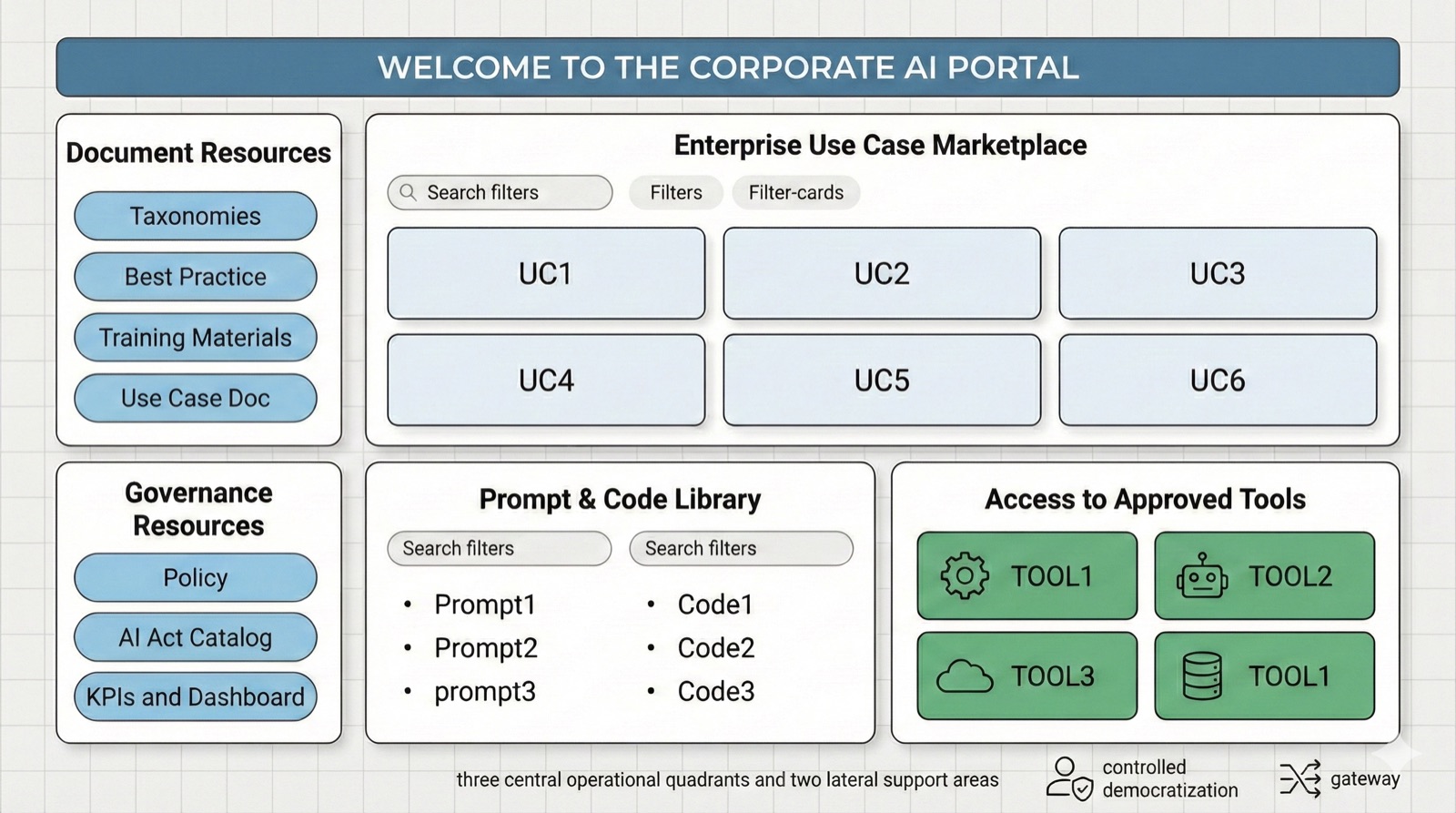
A unified digital environment that acts as an intelligent gateway between human expertise and artificial capabilities, transforming ecosystem complexity into an accessible, governed, and strategically aligned user experience.
Logical Architecture: The Five Domains
The portal is structured into three central operational quadrants and two lateral support areas, reflecting the different modes of interaction with the AI ecosystem.
Enterprise Use Case Marketplace
A dynamic repository presenting all implemented, tested, and validated use cases through an interface that privileges guided discovery. Organized by framework taxonomy with informative cards, filtering by business process, complexity, and organizational impact.
Prompt & Code Library
A practical armory that enables effective interaction with AI technologies. The Prompt Library organizes optimized query templates classified by use case and AI tool. The Code Library collects internally developed source code with documentation, examples, and validation tests.
Access to Approved Tools
Direct access interface to AI tools approved by the Center of Excellence, with Single Sign-On (SSO), role-based authorization, and audit mechanisms for usage tracking.
Documentation Resources
The informational backbone supporting the ecosystem: Taxonomies for semantic consistency, Best Practices (consolidated methodologies and vendor usage instructions), Training Materials for all levels, and Use Case Documentation with technical specifications and lessons learned.
Governance Resources
A system of controls for responsible usage: Policies (internal regulatory framework, ethical principles), AI Act Catalog (EU regulatory compliance, risk evaluation tools), KPIs and Dashboards (usage metrics, performance indicators, ROI measures).
Strategic Value
- Controlled democratization: broad access while maintaining rigorous governance, reducing barriers with integrated security controls.
- Standardization and quality: AI usage consistent with best practices and policies, reduced output variability and scalable solutions.
- Knowledge management: a central repository accessible continuity-wise despite turnover and with facilitated onboarding.
- Data-driven decisions: systematic AI usage data collection, optimized resource allocation, and opportunity identification.
- Regulatory compliance: automated evidence of compliance, effective response to audit requirements, traceability for the AI Act.
Transform Complexity into Opportunity
The proposed framework represents an attempt to close the gap between the theoretical elegance of existing models and concrete operational implementability, offering organizations not only a map of the AI ecosystem but a practical guide for navigating its complexity.
Framework Summary
Two-Dimensional Architecture: Four integration levels (from data exchange to organizational transformation) × four functional domains (Resources, Data, Use Cases, Tools) = complete systemic vision yet operationally manageable.
Two Fundamental Paradigms: Co-Intelligence (Centaur) — AI amplifies human capabilities, control stays with the operator; Cybernetic Workforce (Cyborg) — sophisticated integration, boundary between human/artificial action indistinguishable.
Seven Use Case Types: From individual super-productivity (Personal Assistant, Enhanced Use) to process productivity (Automation, Analytics, Augmented Employee).
Technology Strategies: Make–Build/Configure–Buy to balance flexibility, time, cost, and control.
AI Portal: A democratic gateway that transforms complexity into an accessible, governed, and strategically aligned experience.
Assess AI Maturity
Use the framework to map the current state of your AI ecosystem:
- Which integration levels have you reached?
- Which functional domains are most developed?
- Which use cases generate the most value?
- Where are the critical gaps?
Democratize Access
The AI Portal represents the enabling infrastructure for broad and governed adoption:
- Start with the Use Case Marketplace to catalog implementations
- Develop a Prompt & Code Library to share best practices
- Implement governance mechanisms for AI Act compliance
- Create training paths to build skills
Transform Complexity
Every organization faces unique challenges in AI adoption. The framework provides the map, but implementation requires adaptation to the specific context.
Discover how to apply the framework to define effective governance, identify high-impact use cases, and balance Make/Build/Buy investments.
Explore the Adoption Path